Vela Creations is an in-depth resource for off grid living. The site documents our research and experiences, hoping that they might help others interested in pursuing this lifestyle. This blog is designed to document our day to day experiences as we build our new, sustainable homestead. If you are interested in seeing more photos and videos, we have a flickr account at the following url: http://flickr.com/photos/35090117@N05/collections/

Showing posts with label top bar beehive. Show all posts

Wednesday, April 28, 2010

More Bees


Here's another blog from Abe about "his girls"...

This week we bought 3 Langs (the traditional type of beehive) from a beekeeper about 50 miles from us. So, we had our first experience moving bees in hives, which went pretty smooth, except that I got stung twice, from a purely newbie mistake. I didn't have closed shoes, I wore my sandals, and once the hives were in the truck, a few bees managed to climb up into my sandal, and well.... you know the rest. So, I've been walking around with one big leg and one normal leg for the past 2 days! These stings did not hurt as much as my last prick on my nose, so maybe I am slowly building up a resistance. My foot still got very swollen, and I am going to try and test out a few remedies with bee stings (meat tenderizer, ice, toothpaste) to see if I can keep the swelling down in the future (I could hardly walk the next day).

Anyway, we got the girls settled in pretty easy, and they seem to really like it here. In their old setup, there was not much blooming right now, it was pretty desolate, actually. But here at our place, we have tons of wildflowers, apples, pears, plums, oaks, acacias and tons of other things that are in bloom right now. In fact, it is a bee paradise.

I opened up each hive today just to make sure nothing was out of place, and everyone looked fine to me. I will probably start adding supers soon, as the brood chamber is pretty close to being full. I didn't go through each frame or look for the queens. I want them to settle in a bit more before really getting invasive. I have been feeding them syrup, just while they adjust to the change, and man, they can eat! They've been going through about 600mL a day!

On another front, I also opened up my barrel hive to check on the situation there with the new queen and everything. The ants are still making their way in there, I noticed, but I don't think they are actually doing much harm. They seem to be focused on one of the older combs at the back of the hive that had quite a bit of dead larva in it. The bees were not even maintaining that comb, so I guess it is ok for the ants to have it. I went ahead and took it out of the hive in hopes to draw the ants away.

I didn't see the new queen, but it was pretty difficult, as there are a lot more bees than before. I guess some of the brood comb has hatched since we move them. I thought I saw a small section that looked like it had eggs in it, but I am not quite sure. I also noticed that they haven't built much new comb, yet. They have repaired a lot of the older comb, attaching it to the top bars and such, but not much expansion, yet. I assume they are focused on the new queen.

The queen cells were all opened and on the floor of the hive. I also saw 2 very large, almost developed larva, that I can only assume were queen larva, due to their size. So, I guess the queens did their thing, and I am hoping one killed the others, as is their way.

I did see a few drones in there as well, but not a whole lot. I think they were more apparent because I was looking for the queen, and anything bigger than normal caught my eye.

One thing I did notice in the barrel hive was that they have been storing a lot of pollen. There is a lot more in there than before. The oak tree that they sit under is current blooming, and they are not having to go very far (4 feet vertically) for forage. I am sure the oak is producing a bunch of pollen, and they are taking advantage of the surplus. That might also be a good sign that they are prepping for a lot of babies, soon.

Anyway, it was very nice opening everything up and getting some time with the girls. The new Langs are a bit more aggressive than my barrel hive, but they also have more honey and bigger hives to defend. The barrel hive is growing in numbers of bees, and I hope has a new queen as well, so all in all, things seem to be doing very good with the ladies.

I will probably be able to harvest from the new hives this year, as they were not splits, but working hives from last year.

I have also decided to do an experiment with at least one of the Langs and test out a hive design from a man in South America. Basically, he gives them HUGE amounts of space (the brood chamber is 3 Langs deep, honey stores are 5 full supers). A lot of folks have had huge success with his system, which is very hands off (he only opens the hive once a year). Now that I have a few hives, I can compare different types of hives. I do like the idea of not disturbing them much (though I do like looking at them). In some of the tests that I have seen, folks have been able to harvest over 120 kg of honey from one of his hives (after a 2 year start-up time) compared to a 15-25 kg harvest from normal Lang setups. The large increase in production is attributed by the much larger brood chamber, which allows the hives to become quite big (150K bees or more) and thus, can harvest more honey. Larger hives seem to be more stable and less prone to some of the more common issues (Varroa specifically). This hive is called the Perone Hive (after Oscar Perone, the inventor), and we have been calling it the SuPerone, due to its size (5 feet or taller).

Tuesday, April 13, 2010

A blog from Abe and his Bees

I was fortunate enough to be able to remove a hive from a house down in the village last weekend. It was a wonderful and amazing experience, and it left me with such an appreciation for bees.

Armando's nephew (Luis) is a pro keeper. He has about 30 hives, which he rents them to the orchards. He came down last weekend for Easter, and someone down in the village asked him to remove a hive that was in their roof. Apparently, it had been there for several years.

Well, he didn't have any equipment, but he knew I was interested in bees, as he has been looking for used hives and "splits" for me for some time, now. So, he proposed that we remove the hive together, using my equipment. The deal was that I could have the hive, and we could split any honey, if we found any.

So, I saw it as an awesome opportunity. I have to admit, I was a bit nervous when we arrived at the house. I had never been around bees like that, and I didn't really know how I would react.

We climbed up to the roof and started removing pieces of tin where the bees were coming out of the roof. It soon dawned on us that they were not in this part of the roof, so we went to another part, removed more tin, and later learned that they were not in the roof at all, but down below the insulation just above the sheet rock. It so happened that this was right above a closet, which made it hard to work with the limited space and light.

In any case, we started tearing down sheet rock and quickly found the hive. IT WAS HUGE. It measured about 4 feet long and 3 feet wide. There were so many bees, I could hardly believe it.

We started pulling down combs, one by one. I was on the ground sorting them into "honey" and "brood" piles. Once we got most of the hive down (who knows how long it took, at least 2 hours), we started tying the brood combs to my tops bars and putting them in a box I brought up to serve as a temporary hive.

The honey combs went into a 5 gallon bucket that we quickly filled, so we got another, and it filled up as well.

As things started to calm down a bit, we began looking in the hive I brought, which by this time had tons of bees in it. We were looking for the queen, and I am proud to say that I was the one that spotted her! She seemed ok, but had honey on her, and as the day progressed, she moved less and less. The workers didn't really help her much, which worried us a bit.

We scooped up as many bees as we could, and then we took the hive up to our house. I dropped Luis off at Armando's house so that he could start processing the honey.

I arranged my barrel hive up here in a nice spot under an oak tree with a real nice eastern exposure. Getting the bees into the hive was very easy, I pretty much just poured them in. I ended up with about 6-8 heavy brood combs, all tied up to the tops bars and arranged in the hive really nice. The bees took to the new hive quite well, and I noticed they were even helping the queen a bit, though by this time she was barely moving at all.

Anyway, by the end of the day, we processed about 4 gallons of honey that we split between us. We also gave some to Armando and Estela, plus some to the people whose house we destroyed earlier that day! :)

I did end up getting stung once. When I was pulling down comb, a bee walk right onto my veil, which was pressed up against my face. She stung right through the veil on the tip of my nose. It didn't hurt much, and I just kept on working, and when we were done, Luis pulled the stinger out for me. The next morning I woke up with a big, swollen nose, and I now look like a sesame street character.

All in all, it was a great day, and a wonderful experience. I felt like a pro by the end of it (especially when I spotted the queen!), and I am excited to do it again soon. We will see if the hive survives, as I have doubts about the queen.

So, there you go, my first bee experience. I have been eating the dark, rich honey every since we robbed it, and I can't get enough of it. Luckily, we have a lot, plus a lot of clean wax as well. Leo loves the honey, so we are all just pigging out around here on Dad's latest adventure!

UPDATE 4-13
Yesterday I opened up the hive to look for the queen and also tie a few bits of comb to the top bars. As I was going through the hive, everyone looked really good, but I didn't see any signs of a queen. There was a small piece of comb leaning against the back of the hive, and when I picked it up, the back side was covered with thousands of bees. I thought that I had finally found the queen, but instead were 4 large queen cells. So, the hive is making a new queen, and if my calculations are correct, she should hatch sometime around April 20-25.

More Photos

Saturday, October 24, 2009

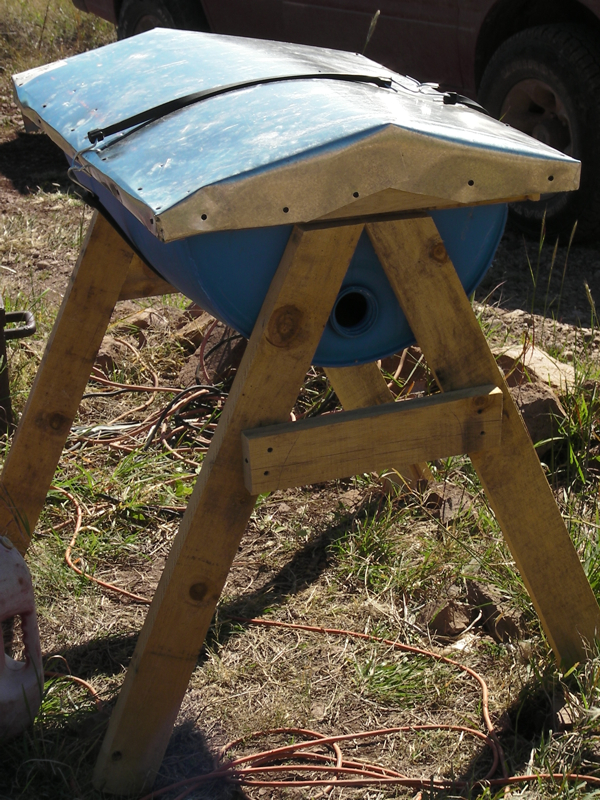
Top Bar beehive

Something very exciting happened this week - we got our prototype top bar beehive made.

We want to start keeping bees as soon as possible, for both honey and pollination, and this method seemed like the best suited to us and our way of life. It is cheap, easy to do, and other people that use the top bar system say that they see a marked reduction in bee diseases. It seems to be the "organic" way to keep bees.

In short, the hive consists of half a barrel on 2"x4" legs, a frame around it on which rest 23 bars for the honeycomb, and a roof. We will be writing a full how-to over the next week or two, which we will post at http://velacreations.com/beehive.html

All we need now is to find a swarm of bees. Usually they swarm - which is when a new queen leaves the old hive with a group of bees, ready to make a new hive - in Spring, although people say that bees do swarm as late as this here.

For more photos, click here.

Blog Archive