 Despite only having three work days this week, due to rain, we have got the first two coats of latex concrete on the kids' rooms roof.
It's too soon to tell, but we think we have found the way we will do roofs from now on. We are always looking for the best way to build, balancing the Time, Cost, Energy factors (strength and durability being things that cannot be compromised). Walls are easy, with endless good options out there, but the roof is one of the most important and expensive elements of a building, and up until now we have not found the system for us. However, that seems to have changed...
Its advantages are that:
- it is very light, so the support structure does not need to be as extensive as with other materials.
- it sets up super fast, so you don't have to be as scared of clouds on the horizon as with concrete.
- it is very fast to apply, almost equally the speed of putting up tin, which is a material we do not want to use as it does not last as long or look or sound (in rain) as nice as concrete options.
- for its strength, durability and speed, it is cheap.
- it allows for many different designs, though a pyramid structure seems to be the most efficient.
We had never tried this method before, but it was very easy. This is what we did:
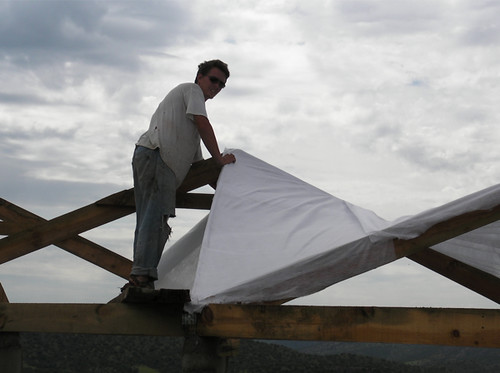
- We made a wooden frame, in a three peak design, set on concrete posts.
- We then stapled two layers of fiberglass screen onto the frame, alternating the direction of the fabric for each layer.
- Once the fabric was in place, we poured our mix onto it and brushed it in with long-handled broom type things. The mix wants to be pretty liquid for this first coat, so that it penetrates the fabric.
- We then used paint brushes to put a slightly thicker mix onto the underside.
- We left three of holes in the structure, at the tops of the peaks, so that we can pour the next coats easier. We will pour these before we do the final coat, when we can walk on top. Latex concrete binds very well to itself, so we do not have to worry about cold joints, as with concrete.
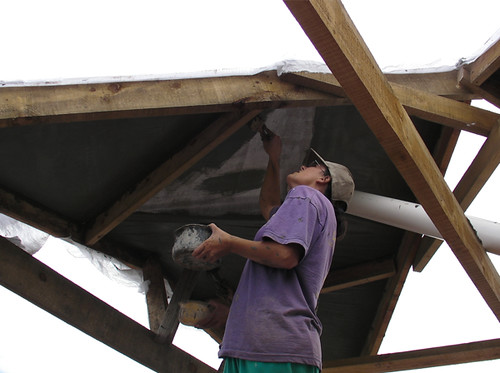
The mix for these first two layers was a 1:1 of acrylic and cement, adding a little water to make it more runny. We used a product called Sikalatex, but we ran out and have moved on to a 100% acrylic concrete bonding.
We will now put 3 more layers on top, though these will consist of a 1:1:1 acrylic, cement, and fine sand. Even after just two coats, the structure is hard (will probably be able to walk on it after just one more coat) and fairly waterproof - water seeps through as it cures, but does not really drip. We should be able to do two coats in a day.
For photos, click here.
